Byte indexing
The single most common reverse-engineering mistake is getting a byte offset wrong — because WiCAN, ISO-TP, and Torque each count bytes differently. Porting a known PID from another tool or car fails silently if you don't account for this.
Three ways to count the same payload
A UDS response arrives as ISO-TP frames on top of CAN. Depending on where you start counting and whether you include the transport's framing (PCI) bytes, the "same" byte has different indices:
- WiCAN index — the index into the raw CAN frame data, including the ISO-TP PCI byte(s). This is what the WiCAN AutoPID feature uses for addressing. It's the source of most of the confusion when porting PIDs.
- ISO-TP index — the index into the pure reassembled ISO-TP payload (PCI stripped). This is what SavvyCAN/ImHex-style tools show.
- Torque / OBDb bix — the index into the actual UDS payload, counted from
the first data byte. Because it skips the service header (SID + subfunction), the
offset depends on the header's size: Torque 1 for
21xxPIDs (1-byte subfunction) and Torque 2 for22xxxxDIDs (2-byte).canair bixreads that from the payload's own service and names the active variant so it's clear the Torque mapping is not fixed (-1/-2override it).
The header is not always "SID + 1 or 2 bytes"
How many bytes sit between the SID and the first data byte is a property of the service, and it is not just a width — the fields have names and an order:
| Response | Header after the SID | First data byte at ISO-TP |
|---|---|---|
62 xx xx … (0x22 ReadDataByIdentifier) |
DID (2) |
3 |
61 xx … (0x21 ReadDataByLocalIdentifier) |
LID (1) |
2 |
41 xx … (OBD-II mode 0x01) |
PID (1) |
2 |
6F xx xx yy … (0x2F IOControl) |
DID (2) + CTRL (1) |
4 |
71 ss xx xx … (0x31 RoutineControl) |
SF (1) + RID (2) |
4 |
7F ss nn (negative response) |
REJ SID (1) + NRC (1) |
— |
Note 0x31 puts its sub-function before the routine id while 0x2F puts its
control parameter after the DID — a 1-vs-2-byte "subfunction width" cannot
express either, which is why canair bix --annotate labels each header field from
the service instead (see below). The table lives in canlib/uds_layout.py.
The WiCAN↔ISO-TP offset depends on the response's length
How many PCI bytes sit in front of the data is not fixed:
| Response | PCI bytes | First data byte |
|---|---|---|
| Single frame (payload ≤ 7 bytes) | one (0x0n) at B00 |
B01 is the SID |
| Multi frame (payload > 7 bytes) | two (0x1n nn) at B00–B01, then one 0x2n at B08, B16, … |
B02 is the SID |
So the same WiCAN index is a different ISO-TP byte depending on the payload
length — a 7-byte 22xxxx response puts its first data byte at B04 = ISO-TP
3 = Torque A, where a long one puts ISO-TP 3 at B05. canair resolves this
from the actual captured payload, so --notation labels and canair bix
--annotate are length-aware. Keep it in mind when hand-converting: assuming
the multi-frame layout on a short response shifts every byte by one.
Because each notation includes or excludes different framing, an expression correct in one is off-by-one-or-two in another.
canair expressions use WiCAN Bnn
Parameter expressions reference bytes as [Bnn] (and bits as [Bnn:k]), using
the WiCAN byte index. So "[B12]" extracts WiCAN byte 12.
Let the tool do the conversion
Don't convert by hand — canair bix is the byte-index converter and, crucially,
annotates a real payload so you can see which byte is which. Run it with no
arguments for a guided overview — a plain-language legend for each notation and
the PCI/SID/PID/DID Role labels, plus a compact 2-frame table:
canair bix # guided overview: legend + a compact 2-frame table
canair bix B09 # quick lookup for WiCAN byte 9 (w9 also works)
canair bix --table # the full conversion table, grouped by CAN frame
canair bix --annotate 62B004… # map a reassembled UDS payload (SID-first, PCI stripped)
canair bix --annotate 1012… --raw # map an already-framed CAN payload (PCI present)
canair bix --annotate 62B004… --torque # add the Torque letter column
canair bix --annotate 62B004… --obdb # add the OBDb bix (bit-index) column
By default --annotate and --table show only the WiCAN, ISO-TP, and
Role columns — WiCAN and ISO-TP are the notations canair expressions use. The
Torque letter column (--torque) and the OBDb bix column (--obdb) are
distinct notations, each opt-in on its own flag, for cross-referencing third-party
PID sheets. Torque notation is what the Torque app, Car Scanner, and similar OBD
apps use; OBDb bix is a separate bit-index scheme.
--annotate expects the reassembled UDS response payload — SID-first, with
the ISO-TP PCI bytes already stripped (what the transport and captures hand back);
it reconstructs the framing to show the WiCAN indices. If instead you have a raw
CAN frame straight off the bus (PCI bytes still present), pass --raw and it
indexes the bytes as-is. bix reliably warns when the input's first byte
contradicts the chosen mode — a UDS response SID (0x40–0x7F) and an ISO-TP PCI
first byte (0x00–0x3F) occupy disjoint ranges — so a raw frame fed without
--raw (or vice versa) is caught rather than silently mislabelled.
--table groups its rows by 8-byte CAN frame with ── Frame N ── dividers and a
Role column that marks the ISO-TP framing (FF PCI / CF PCI) and UDS header
(SID / PID / DID) bytes, so you can see exactly where the raw CAN frame
boundaries fall and which rows are framing rather than data. --annotate marks the
same frame boundaries on a concrete payload.
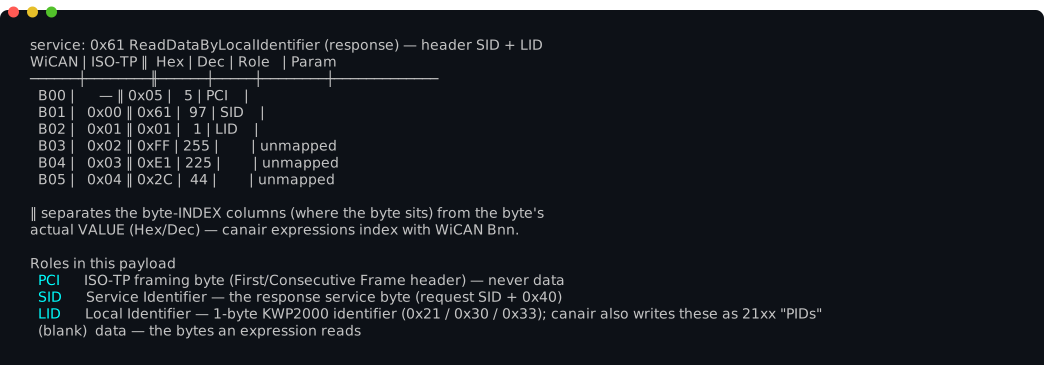
--annotate names each header byte from the service
--table has no payload, so it can only assume a generic SID + PID/DID
header. --annotate does have one, and the response SID identifies the
service — so every header byte is labelled for what it actually is:
| Role | Meaning |
|---|---|
PCI |
ISO-TP framing byte — never data |
SID |
Service Identifier (request SID + 0x40) |
SF |
sub-function byte, selecting the mode within the service |
DID |
Data Identifier — 2-byte UDS identifier (0x22/0x2E/0x2F) |
LID |
Local Identifier — 1-byte KWP2000 identifier (0x21/0x30/0x33); canair writes these as 21xx "PIDs" elsewhere |
PID |
Parameter ID — 1-byte OBD-II parameter (modes 0x01/0x02) |
RID |
Routine Identifier — 2-byte UDS routine id (0x31) |
CTRL |
inputOutputControlParameter — what the ECU was told to do |
REJ SID |
the rejected service's SID, echoed in a negative response |
NRC |
Negative Response Code — why the request was refused |
| (blank) | real data — the bytes your expression reads |
A definition list of just the roles the payload used is printed underneath the
table (suppress it with --no-legend). A negative response also spells out the
code, e.g. NegativeResponse rejecting 0x22 ReadDataByIdentifier — NRC 0x31
requestOutOfRange, so a refused read explains itself instead of showing the NRC as
a data byte.
An unrecognised service falls back to the generic SID + PID/DID labelling
using the width from -1/-2 or --pid.
Add --ecu ECU --pid PID to --annotate to overlay which defined parameter maps
each byte and flag unmapped data bytes — the fastest way to catch a wrong
offset in an expression:
--pid also settles the subfunction width when the payload's own service can't:
a 22xxxx DID has a 2-byte echo, a 21xx PID a 1-byte one. You rarely need it now
that the response SID is read directly — it matters for a payload whose service
canair doesn't recognise. An explicit -1/-2 overrides everything, and bix
warns when it contradicts the payload's service (or, failing that, the PID):
⚠ WARNING  -1 contradicts the payload: SID 0x62 is ReadDataByIdentifier (response),
           whose header is SID + DID(2B) (2 byte(s) after the SID).
Write the PID with its full service prefix (22B004, not the short B004) if you
are relying on it: a short-form DID doesn't state its service, so it can't be told
from a 1-byte PID.
Switch the notation in analysis output
The analysis commands — correlate, hunt, investigate, coverage, and
decode (--discriminate/--find-mirrors) — label raw bytes as WiCAN Bnn by
default. Pass --notation to re-render those labels in whichever notation you
find easiest to read or need for cross-referencing:
canair correlate --against ESC:22C101:REAL_SPEED_KMH --bytes   # B10, B14 … (default)
canair correlate --against ESC:22C101:REAL_SPEED_KMH --bytes --notation isotp   # i7, i11 …
canair coverage BMS 2101 --unmapped --notation torque          # A, B, F …
--notation takes wican (default), isotp, torque, or bix. It only
changes display — named signals are untouched, and the machine-readable
--json output and --promote always use the canonical WiCAN form (the
promotable/firmware expression). Set a persistent default with:
Internally canair models a byte position in ISO-TP space (the canonical, framing-free payload index) and derives the WiCAN / Torque / bix views from it — so WiCAN is treated as one view of the byte, not the tool's native unit.
The byte ruler in the value views
canair monitor --rulers (r in the TUI) and canair captures --diff/--step
--rulers draw a single ruler row above the payload hex, numbering each byte
column in your chosen notation — and each signal's byte-reference column (next to
its value) is rendered from the same notation, so a value and the ruler always
name the byte the same way:
      SOC_BMS      92.50 %  ✓  B9
      BATTERY_POWER 0.71 kW ✓  B15,B17-B19
 wican   02 03 04 05 06 07 09 10 11 12 13 14 15 17 18 19 …
         61 01 FF FF FF FF B4 24 A4 26 48 03 00 05 0F 30 …
Both views take --notation too (and honour display.byte_notation). Note that
a run of payload bytes can be non-adjacent as rendered — WiCAN interleaves PCI
framing bytes, so four consecutive payload bytes show as B15,B17-B19 rather
than a B15-B19 that would claim the framing byte. bix is a bit index, so it
cannot fit a two-character byte column; a ruler asked for it falls back to WiCAN
rather than skewing the columns (the row label always says which notation is
actually drawn).
Further reading
For the deep, firmware-grounded reference — exactly how the WiCAN Bnn index maps
onto the raw CAN frame buffer, verified against wican-fw source with file/line
citations — see WiCAN byte index (firmware reference).
The full conversion table is available any time via canair bix --table, and the
upstream discussion of the notation differences is in
meatpiHQ/wican-fw#514.